
Artist on Board is a pilot program within NATURE OF US project testing a new format of art-sci exchange allowing for an artist or artistic team to be involved in an ongoing scientific research project, actively engaging the artists in a concrete scientific theme, leveraging their skills in the development, dissemination and the results. Scope of the artist’s participation in the scientific project as well as schedule will refer to proposed idea and will be discussed with a chosen artist or artistic team and organisers of the projects.
The two proposed in the open call projects, BROZ and Baltic Sea2Land deal with far-reaching environmental issues and were selected together with the NATURE OF US Art/Sci Committee as ongoing researches offering opportunity for scientific knowledge and methodology sharing with a potential for art-sci exchange, innovation and experimentation.
Artist on Board is addressed to individual artists or artistic teams interested in engaging in exploration within experimental practices at the intersection of art and science, eager to incorporate innovative and creative approaches into their work.
The program aims to foster art-sci dialogue and interdisciplinary exchange by creating opportunity:
– to expand the understanding of scientific concepts related to climate change;
– for artists, to gain inspiration to explore new themes, ideas, and narratives for artistic work and practices;
– for scientists, to gain a platform to communicate their research in more accessible, engaging formats;
– network with like-minded individuals and organizations and enhance possible future collaborations;
Artists, individual or artistic teams residing and/or actively working in the partner countries (HU, CZ, PL, SK) are eligible to apply.
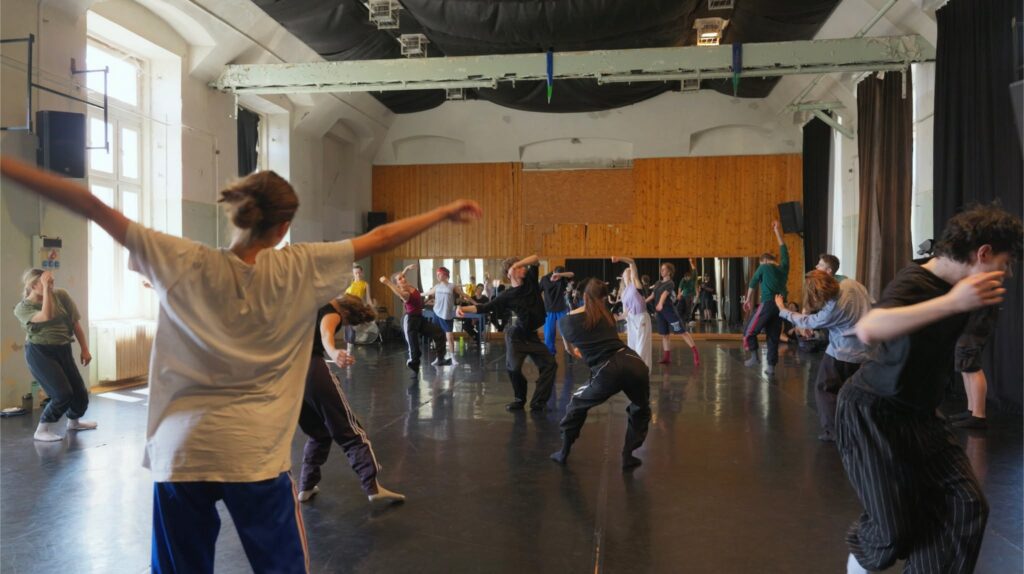
This is an opportunity to join scientific projects for contemporary dance and performance creators interested in developing artistic practice in close dialogue with ongoing scientific research allowing for deeper cooperation and exchange between the two fields. The duration of the process and the intensity (online and in residence meetings) will be determined by the mutual agreement between the applicant and the organisation, up to a maximum of 100 days.
Proposed projects (one to be chosen for each application):
1. NAME OF THE PROJECT: Restoration of wetlands and river side arms
ORGANISER OF THE PROJECT: BROZ, ecosystem conservation NGO
PROJECT LOCATION: Bratislava/Slovakia
TIME FRAME OF THE PROJECT: A long-term project. Participation will depend on the artists’ requirements and the agreement of both parties, possible cooperation open until May 2026.
MAIN FIELD OF THE PROJECT: Protection of the remaining Danube wetlands, restoration of riverside arms on the Danube river and enhancing water dynamics.
SHORT DESCRIPTION OF THE PROJECT: The Danube inland delta located south of Bratislava represents one of the biggest wetland complexes left in Central Europe although 80% of water intake has been lost already due to Gabčíkovo water dam construction. The remains of this once massive wetland complex is still appreciated for its ecosystem services such as water retention and purification and rare biodiversity. Black storks and white tailed eagles are still seen nesting in the area, European beavers and otters can still be found in the old side arms. Animal population numbers declined rapidly and the highest loss is documented on fish population which declined by 70%. In order to protect the remaining Danube wetlands it is necessary to make interventions to restore water dynamics, make the simulated floods at least two times per year and save this area and all its remaining biodiversity. To this day, BROZ has successfully restored more than 500 ha of wetlands and improved water dynamics on another 2000 ha in the inland delta. It has also restored a total of five river branches in the area and is currently working on new projects to continue this work. You can read more about BROZ here.
2. NAME OF THE PROJECT: Baltic Sea2Land
ORGANISER OF THE PROJECT: Interreg programme with Climate and Ocean Research and Education Lab within The Institute of Oceanology of Polish Academy of Sciences as a partner
THE PROJECT LOCATION: Sopot/Poland
TIME FRAME OF THE PROJECT: possible cooperation until end of 2025
MAIN FIELD OF THE PROJECT: Multi Level Governance in coastal areas
SHORT DESCRIPTION OF THE PROJECT: Coastal areas are valuable territories for housing developers, tourism and industry. For this reason, human interventions require careful and sustainable actions for the sake of the natural environment of these areas. Baltic Seas2Land project focuses on the coastal area of the Baltic Sea Region, its restoration, protection and sustainable development. The mission of encompassing the coastline with a special support is only possible with integrated actions of different sectors involved in the landscape. The project refers directly to Multi Level Governance (MLG) aiming to engage local communities, public authorities, environmental science and business in undertaking common actions. To enhance the cross-sectoral collaboration the Sea2Land Navigator tool is being developed. It is meant to guide and support stakeholders through challenges of the coastal future. You can read about Baltic Sea2Land here.
WHAT DO WE OFFER?
- EUR 2200 (including travel, accommodation, fees (incl. per diem) altogether for the artist/ team);
- Meeting the project organisers and the wider team;
- Opportunity to follow an participate the scientific research process;
- Opportunity to develop artistic research within an interdisciplinary context.
HOW TO APPLY?
- fill out and submit the APPLICATION FORM
DEADLINE: 15th June 2025
Results will be announced by 30th June 2025.
For more information contact: team@natureofus.art
// You may apply to join for both projects, in which case a separate application form needs to be submitted for each proposal. One applicant may receive one project cooperation opportunity.
“Funded by the European Union. Views and opinions expressed are however those of the author(s) only and do not necessarily reflect those of the European Union or the European Education and Culture Executive Agency (EACEA). Neither the European Union nor the EACEA can be held responsible for them.”